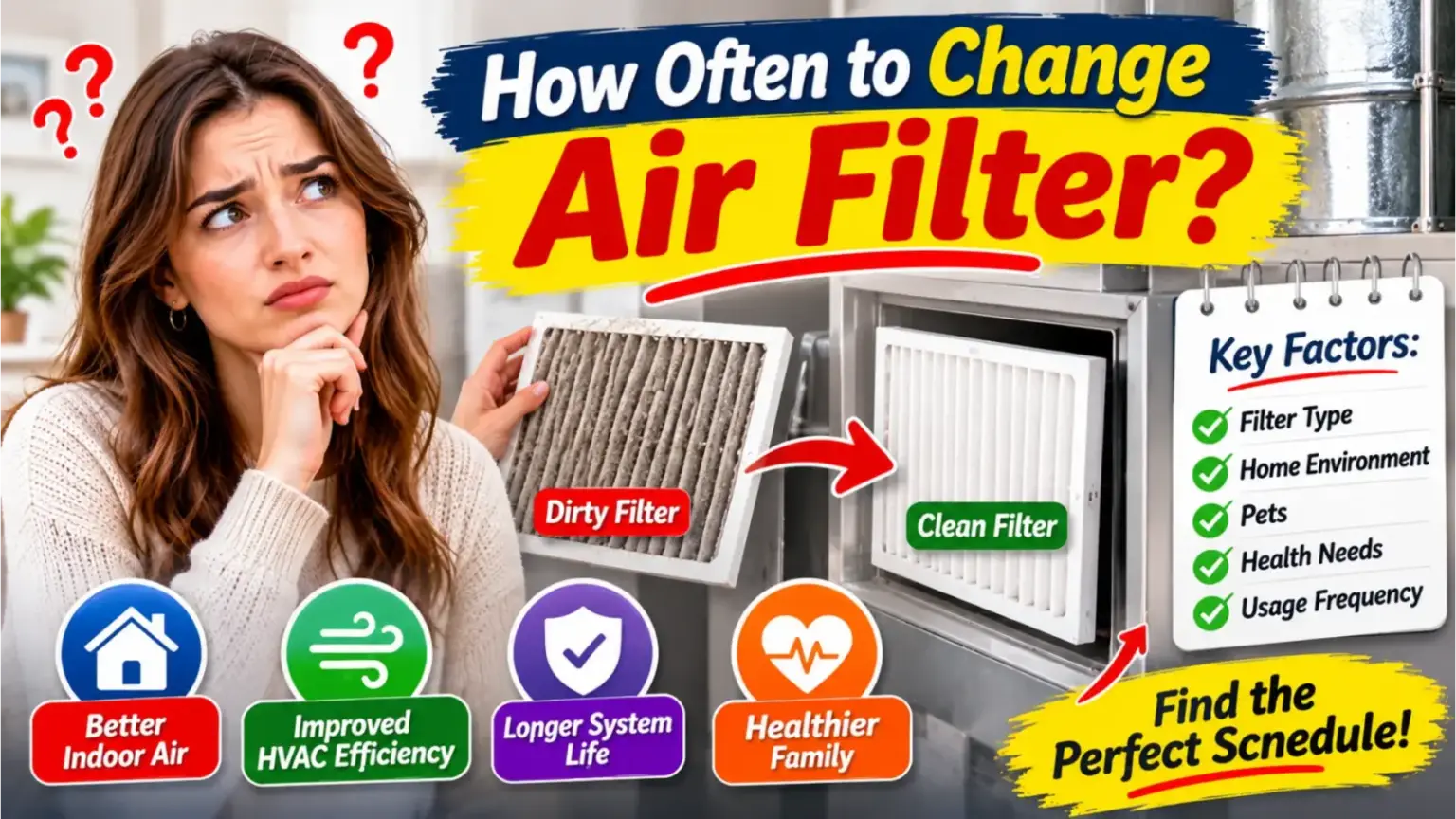
How Often to Change Air Filter in Your Home HVAC
Here is the short answer on how often to change air filter in a home heating and cooling system. Check it every month. Replace a standard 1 inch filter every 1 to 3 months, and a thick 4 to 5 inch media filter every 6 to 12 months. ENERGY STAR says to change the filter whenever it looks dirty and at least every three months. Homes with pets, allergies, smokers, or heavy system use usually need changes on the shorter end of the range.
Your furnace filter and AC filter are usually the same part in a central system, so one schedule covers both. Below you will find a schedule by filter size and household, signs it is time to swap, how to pick the right MERV rating, and step by step replacement instructions.
Air Filter Replacement Schedule at a Glance
| Filter type | Typical home | Pets, allergies, or heavy use |
|---|---|---|
| 1 inch fiberglass (flat panel) | Every 30 days | Every 30 days |
| 1 inch pleated (MERV 8 to 11) | Every 60 to 90 days | Every 30 to 60 days |
| 2 inch pleated | Every 2 to 3 months | Every 1 to 2 months |
| 4 to 5 inch media filter | Every 6 to 12 months | Every 3 to 6 months |
| Washable or electrostatic | Clean monthly | Clean every 2 to 4 weeks |
| Vacation or rarely used home | Check each visit | Replace when dirty |
These are starting points, not expiration dates. A monthly visual check is what tells you your real schedule.
What ENERGY STAR and the EPA Recommend
ENERGY STAR, the EPA’s energy efficiency program, gives a simple rule. Check your filter every month, especially during heavy use months in winter and summer. If it looks dirty after a month, change it. At a minimum, change it every three months.
The reason is airflow. A dirty filter slows air moving through the system, so your furnace, air conditioner, or heat pump has to work harder to heat or cool your home. That wastes energy and puts extra strain on parts like the blower motor.
Factors That Change Your Filter Schedule
Two homes with the same filter can need very different schedules. These factors make filters load up faster:
- Pets: fur and dander clog filters quickly. Each extra pet shortens the interval.
- Allergies or asthma: fresher filters help keep pollen, dust mites, and mold spores out of the air.
- Smoking indoors: smoke particles coat filter media fast.
- Heavy system use: peak summer and winter months mean more air passes through the filter.
- Running the fan on “on”: continuous fan mode filters air all day, so the filter fills sooner.
- Home size and people: more occupants mean more dust, skin flakes, and lint.
- Renovation or construction: drywall and sawdust can clog a filter in days.
- Wildfire smoke or high pollen: outdoor air quality affects indoor filters too.
- Higher MERV rating: finer filters catch more particles and can load up sooner.
Suggested Schedule by Household
| Household | 1 inch pleated filter | 4 inch media filter |
|---|---|---|
| Single person, no pets, no allergies | Every 90 days | Every 9 to 12 months |
| Typical family, no pets | Every 60 to 90 days | Every 6 to 9 months |
| One pet | Every 60 days | Every 4 to 6 months |
| Several pets or allergies | Every 30 to 45 days | Every 3 to 4 months |
| Smoker in home or renovation dust | Every 30 days | Check monthly |
Filter Schedules by HVAC System Type
The kind of equipment you have also shapes the schedule, mostly because of how many hours the blower runs each year.
- Gas or oil furnace: runs mainly in winter. In homes without central AC, filters may last longer in the off season, but check before the first cold snap.
- Central air conditioner: shares the furnace blower and filter. Summer use adds a second heavy season, so filters load up year round.
- Heat pump: heats and cools with the same air handler, so it may run in every season. Check monthly all year.
- Systems with a whole house air purifier or UV light: follow the add on’s own schedule for media and bulbs, plus the main filter.
- Systems with continuous fan or fresh air ventilation: more total airflow means more frequent changes.
How Climate and Location Affect Filters
Where you live matters as much as what you own. Hot, humid climates often run the AC for long stretches, so filters see more air. Dry, dusty, or windy areas push more grit into the home. Homes near busy roads, farms, or construction sites also tend to load filters faster.
During wildfire smoke events, the EPA suggests a MERV 13 filter or the highest your system allows. Smoke can fill a filter quickly, so check it every week or two while smoke lingers, and replace it once the air clears.
In mild seasons when the system barely runs, a filter can last longer. Use the monthly check to decide, rather than changing on a fixed date.
Signs Your Air Filter Needs Changing Now
A quick look once a month takes less than a minute and is the most reliable way to set your schedule. Pull the filter out, hold it up to a light, and compare it with a new one.
Do not wait for the calendar if you notice any of these:
- The filter looks gray, dark, or caked with dust instead of white or light colored.
- You cannot see light through a pleated filter when you hold it up.
- Weak airflow from vents or rooms that never reach the set temperature.
- More dust on furniture than usual.
- Allergy symptoms that get worse indoors.
- Higher energy bills with no change in thermostat habits.
- The system runs longer cycles or turns on and off often.
- A musty or burning dust smell when the system starts.
- Frost or ice on the indoor AC coil or refrigerant line in summer.
What Happens If You Never Change Your Filter
A clogged filter does more than let dust through. Restricted airflow can lead to:
- Higher energy use: the blower works harder to pull air through.
- Frozen AC coils: low airflow over the evaporator coil can cause ice and poor cooling.
- Furnace overheating: a furnace may shut off on its high limit safety switch and cycle on and off.
- Dirty ducts and coils: dust that bypasses a clogged filter builds up inside the system.
- Shorter equipment life: extra strain wears out motors and parts sooner.
- Poorer indoor air quality: the filter stops doing its job of catching particles.
ENERGY STAR notes a clean filter helps prevent dust and dirt buildup that can lead to costly maintenance or early system failure.
Understanding MERV Ratings
MERV stands for Minimum Efficiency Reporting Value. It rates how well a filter captures particles of different sizes. Higher numbers catch smaller particles.
| MERV range | What it catches | Common use |
|---|---|---|
| 1 to 4 | Large dust, lint, carpet fibers | Basic fiberglass, equipment protection |
| 5 to 8 | Dust, pollen, mold spores, pet dander | Standard homes |
| 9 to 12 | Finer dust, more allergens, some smoke | Pets and allergies |
| 13 to 16 | Fine particles, smoke, many bacteria and virus carrying droplets | Best home filtration if the system allows |
Some brands use their own scales, like MPR or FPR. Check the package for the matching MERV value.
Which MERV Rating Should You Choose?
The EPA’s Guide to Air Cleaners in the Home recommends a furnace or HVAC filter rated at least MERV 13, or as high as your system will accommodate. Many systems ship with a MERV 8 filter by default.
Before you upgrade, check your furnace or air handler manual, or ask an HVAC technician. A higher MERV filter in a thin 1 inch slot can restrict airflow on some older or smaller systems. A 4 or 5 inch media cabinet handles high MERV filters more easily, because the deep pleats offer much more surface area. Whichever you choose, a higher MERV filter should be checked more often.
Disposable vs Washable Air Filters
| Type | Pros | Cons |
|---|---|---|
| Fiberglass disposable | Very cheap, low airflow restriction | Catches little, needs monthly changes |
| Pleated disposable | Good filtration, easy to find, many MERV levels | Ongoing cost |
| Deep media cartridge | High filtration, long life, steady airflow | Needs a special cabinet, higher cost per filter |
| Washable or electrostatic | Reusable, less waste | Must be cleaned often and dried fully; usually lower filtration |
Never reinstall a washable filter while it is damp, because moisture can encourage mold growth. Most pleated MERV 13 filters are not washable. Rinsing or vacuuming them can damage the media.
How to Find Your Filter and Its Size
Filters usually sit in one of these places:
- a slot in the furnace or air handler cabinet, near the blower;
- behind a return air grille on a wall or ceiling;
- a separate media filter cabinet attached to the furnace.
The size is printed on the edge of the old filter, such as 16x25x1 or 20x25x4. The numbers are length, width, and depth in inches. Note that the printed nominal size may be a little larger than the actual measured size. Buy the size printed on the frame.
Some homes have more than one return grille, each with its own filter. Check every return so none get missed.
How to Change Your Air Filter Step by Step
- Turn the system off at the thermostat so it does not pull dust in while the filter is out.
- Open the filter slot or grille and slide the old filter out slowly so dust does not fall.
- Check the size printed on the frame and match it with your new filter.
- Find the airflow arrow on the new filter. It should point toward the furnace or air handler, away from the return duct.
- Slide in the new filter so it fits snugly with no gaps around the edges.
- Close the door or grille and turn the system back on.
- Write the date on the filter frame and set a reminder for your next check.
- Bag the old filter and throw it away to keep dust contained.
A filter that fits loosely lets air sneak around the edges, so dirty air skips the filter entirely. Snug fit matters as much as filter quality.
Seasonal Air Filter Checklist
| Season | What to do |
|---|---|
| Spring | Replace filter before cooling season, schedule AC tune up, watch for pollen loading |
| Summer | Check monthly during heavy AC use, replace when gray |
| Fall | Replace filter before heating season, schedule furnace tune up |
| Winter | Check monthly during heavy furnace use, keep spares on hand |
ENERGY STAR suggests checking the cooling system in spring and the heating system in fall, when contractors are less busy.
Tips to Make Filters Last Longer
- Vacuum floors and dust surfaces often, especially in homes with pets.
- Groom pets regularly to reduce shedding indoors.
- Seal leaky ducts so unfiltered attic or crawl space air is not pulled in.
- Turn the system off during sanding or drywall work, cover nearby return grilles, and change the filter when the project ends.
- Keep windows closed on high pollen or smoky days.
- Buy filters in multi packs so a replacement is always ready.
Rental Properties and Vacation Homes
Empty homes still collect dust, but the system runs far less. For vacation homes, check the filter each visit and change it when it looks dirty. For rentals, landlords often set a filter schedule in the lease or handle it during routine inspections. A simple log taped near the furnace, with dates and filter sizes, keeps everyone on track.
Other Filters in Your Home and Car
People searching for air filter schedules sometimes mean other filters. Here is a quick guide:
- Window and portable AC units: most have a washable mesh filter. Check the manual and clean it regularly during cooling season.
- Ductless mini split systems: indoor heads have washable filters that need cleaning on the schedule in your owner’s manual.
- Portable air purifiers: HEPA and carbon filters follow the manufacturer’s schedule, often shown by a filter light.
- Car engine and cabin air filters: follow the interval in your vehicle owner’s manual, and replace sooner in dusty conditions.
Frequently Asked Questions
Is it OK to change the air filter every 6 months?
Only for thick 4 to 5 inch media filters in clean homes. A standard 1 inch filter left for 6 months is usually badly clogged. ENERGY STAR advises changing at least every 3 months.
How often should I change my air filter with pets?
Plan on every 30 to 60 days for a 1 inch pleated filter with one or more pets. Check monthly and change it sooner if you see fur and dust buildup.
Is the furnace filter the same as the AC filter?
In most homes with central air, yes. The furnace and AC share an air handler and one filter, so the same schedule applies.
Can I change my air filter too often?
Changing it more often will not hurt your system, but it costs more. A monthly check helps you avoid replacing clean filters.
Which way does the air filter arrow go?
The arrow points in the direction of airflow, toward the furnace or air handler and away from the return grille.
Does a dirty air filter raise energy bills?
Yes. A dirty filter slows airflow and makes the system work harder, which wastes energy. Results vary by home and system.
Can a dirty air filter make you sick?
A clogged filter captures fewer particles, so more dust, pollen, and dander may circulate. That can worsen allergy or asthma symptoms for some people.
Is MERV 13 too high for my system?
The EPA says to use at least MERV 13 or the highest your system can accommodate. Check your equipment manual or ask a technician, especially if you have a 1 inch filter slot.
How often should I change my air filter in summer?
Check it monthly. Heavy AC use means more air moves through the filter, so many homes need a change every 1 to 2 months in summer.
Should I change my air filter if I rent?
Check your lease. Many landlords make tenants responsible for filter changes. If not, let your landlord know when it looks dirty.
How do I remember to change my air filter?
Write the install date on the filter frame, set a phone reminder, or use a smart thermostat with a filter alert. Some people tie the check to paying a monthly bill.
Do thicker filters really last longer?
Yes. A 4 or 5 inch media filter has much more pleated surface area than a 1 inch filter, so it holds more dust before airflow drops.
Final Thoughts
When it comes to how often to change air filter, the best rule is simple: check monthly, change when dirty, and never go past three months for a standard 1 inch filter. Thick media filters can last 6 to 12 months, while pets, allergies, and heavy use shorten every schedule. Pick the highest MERV rating your system handles, make sure the filter fits snugly with the arrow pointing the right way, and write the date on the frame. Your HVAC system, energy bill, and lungs will all thank you.
Keep reading
 Home Safety
How to Baby Proof a Fireplace: Complete Safety Guide
 Cleaning
How to Clean Baseboard Heaters Safely and Thoroughly
More in HVAC & Air Quality →