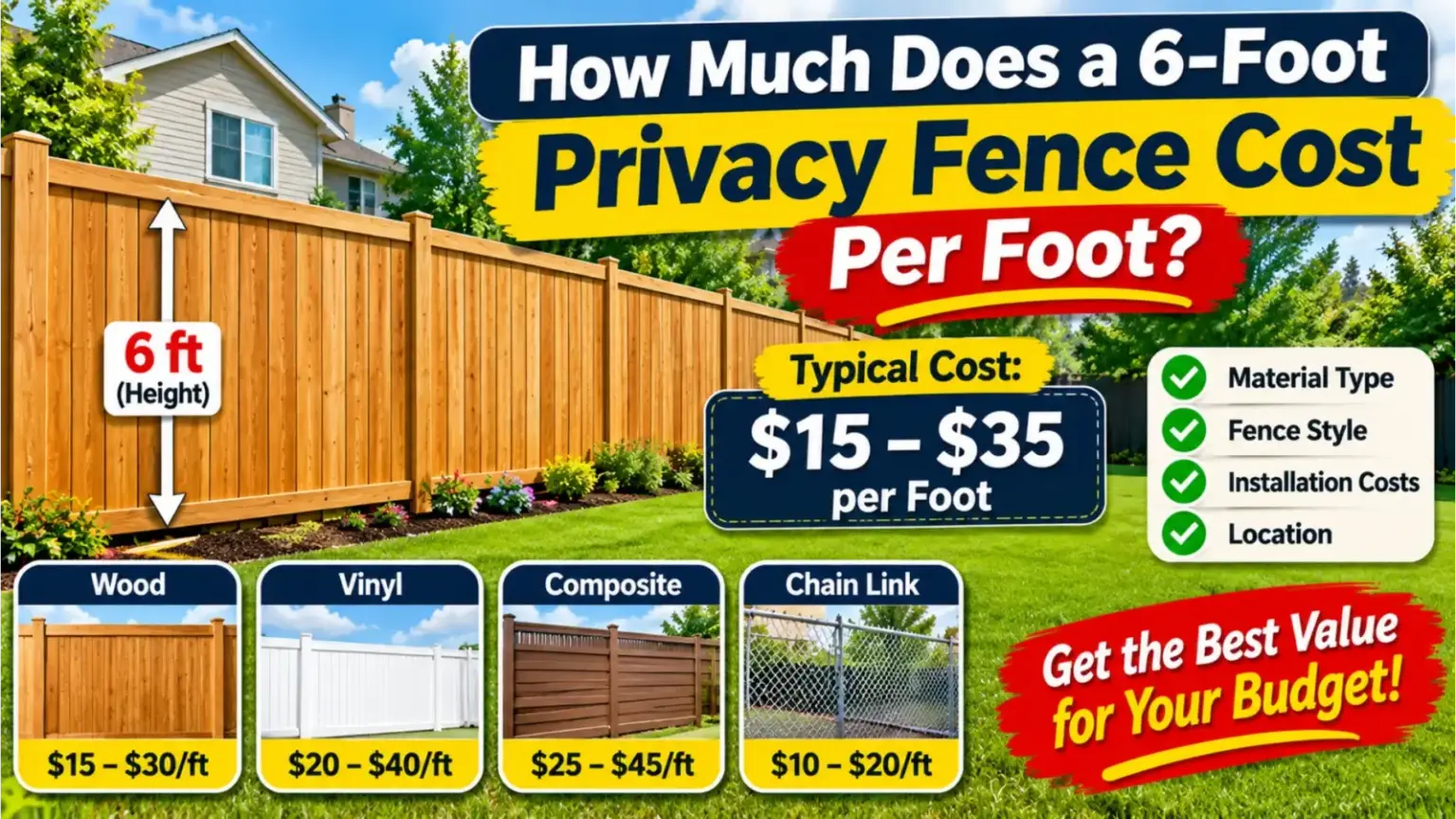
How Much Does a 6-Foot Privacy Fence Cost per Foot?
Here’s the quick answer to how much does a 6-foot privacy fence cost per foot: most homeowners pay roughly $25 to $60 per linear foot installed for a 6-foot wood or vinyl privacy fence, with pressure-treated wood at the low end and vinyl at the higher end. Composite and aluminum privacy fencing cost more. For a typical 150-foot backyard, that works out to about $3,750 to $9,000 for wood or vinyl, before gates, permits, and extras.
Your actual price depends on the material, your region’s labor rates, the terrain, the number of gates, and whether old fencing needs to come out. This guide breaks down 6-foot privacy fence costs by material, labor vs materials, total cost by fence length, hidden costs, DIY savings, and how to get an accurate quote.
Note: Prices below come from published national cost guides and change over time and by location. Use them for planning, and get local quotes for exact pricing.
6-Foot Privacy Fence Cost per Foot by Material
Material is the biggest driver of price. Here are typical installed ranges reported by national cost guides for a 6-foot privacy fence:
| Material | Typical Installed Cost per Linear Foot | Lifespan | Maintenance |
|---|---|---|---|
| Pressure-treated pine | Low end, about $25 to $35 | About 15 to 20 years | Stain or seal every few years |
| Cedar or redwood | About $25 to $50 | About 15 to 25+ years | Stain or seal every few years |
| Vinyl (PVC) | About $30 to $60 | About 20 to 30 years | Very low; occasional washing |
| Composite | Often $30 to $85, depending on brand | Often 25+ years | Low |
| Aluminum privacy panels | Often $50 to $130 | Often 30+ years | Very low |
| Bamboo | Often under $25 | Shorter | Moderate |
| Chain link with privacy slats | Lowest, often under $25 plus slats | Long frame life | Low; partial privacy only |
Ranges vary between guides because of different data sets, regions, and fence styles. For example, a HomeGnome privacy fence cost guide lists wood at $16 to $39, vinyl at $27 to $50, composite at $31 to $59, and aluminum at $52 to $90 per linear foot installed, while other guides report higher numbers for 6-foot designs in high-cost areas.
Wood Privacy Fence Cost
Wood is the most popular and usually the most affordable privacy fence. Pressure-treated pine costs the least. Cedar and redwood cost more but naturally resist rot and insects. Board-on-board, shadowbox, and horizontal designs use more lumber and labor than a basic dog-ear stockade style, so they cost more per foot. Plan for staining or sealing every few years to protect the wood.
Vinyl Privacy Fence Cost
Vinyl costs more upfront than wood but needs almost no maintenance. It won’t rot, splinter, or need painting. Price depends on panel thickness, color (white is often cheapest), texture, and post reinforcement. In very windy areas, reinforced posts or heavier panels add cost.
Composite and Aluminum Privacy Fence Cost
Composite blends wood fibers and plastic for a wood look with low maintenance. Aluminum privacy panels and slatted aluminum fences are among the most expensive options but last a long time with very little upkeep.
Cost by Fence Style
The same material can cost very different amounts depending on the style. Here’s how common 6-foot privacy styles compare:
| Style | Description | Relative Cost | Privacy |
|---|---|---|---|
| Stockade | Pointed pickets set side by side in panels | Lowest | Good; small gaps may appear as wood shrinks |
| Dog-ear | Pickets with clipped top corners | Low | Good |
| Flat top with cap | Pickets trimmed level with a top cap board | Moderate | Good |
| Board-on-board | Overlapping pickets on alternating sides | Higher | Excellent; no see-through gaps |
| Shadowbox | Pickets alternate on each side with spacing | Higher | Good; lets some air through |
| Horizontal | Boards run sideways for a modern look | Higher | Excellent |
| Lattice top | Solid fence with decorative lattice on top | Higher | Good |
Board-on-board and horizontal styles use more lumber and take more labor, so expect them toward the top of your material’s price range.
Materials vs Labor: Where the Money Goes
For most installed fences, labor makes up a large share of the total, often close to half. According to Fixr’s 6-foot privacy fence cost guide, materials alone for a 6-foot privacy fence run about $5 to $20 per foot for wood, $30 to $35 for vinyl, and $30 to $33 for composite.
- Materials: pickets or panels, posts, rails, concrete, fasteners, and hardware.
- Labor: layout, digging post holes, setting posts in concrete, building or hanging panels, gates, and cleanup.
- Why labor varies: local wage rates, soil type (rocky ground is slower), slope, access, and design complexity.
Total Cost by Fence Length
These estimates multiply common fence lengths by a $25 to $60 per foot installed range for a 6-foot wood or vinyl privacy fence. They don’t include gates, permits, or removal.
| Fence Length | Low ($25/ft) | High ($60/ft) | Typical Yard |
|---|---|---|---|
| 50 feet | $1,250 | $3,000 | Short side yard or one property line section |
| 100 feet | $2,500 | $6,000 | Small backyard |
| 150 feet | $3,750 | $9,000 | Average backyard |
| 200 feet | $5,000 | $12,000 | Larger backyard |
| 250 feet | $6,250 | $15,000 | Large lot |
| 300 feet | $7,500 | $18,000 | Large lot or full perimeter |
For a real-world comparison, Fixr reports a national average of about $3,150 to $4,950 to install a 6-foot privacy fence, with most people paying around $4,000 for 150 linear feet of dog-ear redwood fencing.
How to Estimate Your Own Fence Cost
- Measure the fence line in linear feet with a measuring wheel or long tape. Don’t count the house wall or existing fences you’re keeping.
- Subtract gate openings, since gates are priced separately.
- Multiply by the per-foot price for your chosen material.
- Add gates, permits, removal, and extras.
Hypothetical example: a backyard needs 160 feet of fence with one 4-foot walk gate. That leaves 156 feet of fence. At $35 per foot installed, the fence costs about $5,460, plus the gate and any permit fees.
Extra and Hidden Costs to Budget For
| Item | Why It Adds Cost |
|---|---|
| Gates | Priced per gate; double drive gates and heavy-duty hardware cost more |
| Old fence removal | Tear-out and hauling are often charged per foot |
| Permits | Many towns require a permit for 6-foot fences; fees vary |
| Property survey | Confirms exact property lines before building |
| Slopes and uneven ground | Stepped or racked panels take more time and material |
| Rocky or root-filled soil | Post holes take longer to dig |
| Clearing brush or trees | Extra labor before work begins |
| Post caps, lattice tops, decorative trim | Add style and cost per foot |
| Staining or sealing wood | Initial finish and repeated maintenance |
| Utility marking | Usually free through your local call-before-you-dig service, but required |
What Affects the Price per Foot?
- Material and grade: cedar costs more than pine; thicker vinyl costs more than thin vinyl.
- Fence style: board-on-board, shadowbox, and horizontal styles cost more than stockade or dog-ear.
- Post type: 4×4 wood posts, 6×6 posts, steel posts, or reinforced vinyl posts all change the price.
- Location: labor and material prices are higher in many urban and coastal areas.
- Project size: very short fences often cost more per foot because of setup and minimum charges.
- Season and demand: busy spring and summer seasons can mean higher prices and longer waits.
- HOA and local rules: required materials, colors, or styles can raise costs.
Is a 6-Foot Fence More Expensive Than a 4-Foot Fence?
Yes. A taller fence needs longer posts, deeper post holes, more boards or bigger panels, and often a third rail, so materials and labor both go up. An 8-foot fence costs more again and is often limited by local height rules. Six feet is the most common height for backyard privacy because it blocks most sightlines and is usually the maximum many towns allow for backyard fences without special approval.
DIY vs Professional Installation
| DIY | Professional | |
|---|---|---|
| Cost | Materials and tool rental only | Materials plus labor and overhead |
| Time | Several weekends for most yards | Often a few days |
| Skill needed | Layout, digging, setting plumb posts in concrete | Handled by the crew |
| Warranty | Material warranty only | Often a workmanship warranty too |
| Risks | Leaning posts, uneven tops, line mistakes | Lower if you hire a reputable installer |
DIY can save a large share of the cost if you have the time, tools, and skills. Setting posts plumb and in a straight line is the hardest part. If you DIY, call your local utility-locating service before digging and confirm your property line.
Regional Price Differences
Where you live can change your price as much as the material you choose. Labor rates, lumber availability, delivery costs, and local demand all vary. Many cost guides report higher prices in big coastal cities and lower prices in rural areas and parts of the South and Midwest. Frost lines matter too: colder regions often need deeper post holes, which adds labor. The only way to know your local price is to get quotes from nearby installers.
Signs of a Quality Fence Installation
- Posts set deep enough for your soil and frost line, usually set in concrete or well-compacted gravel.
- Posts are plumb and evenly spaced, typically no more than about 8 feet apart.
- Ground-contact rated lumber for wood posts.
- Galvanized or stainless fasteners that won’t rust and streak.
- A consistent top line that follows the ground or steps neatly on slopes.
- Gates that swing freely and latch without sagging.
- A small gap at the bottom of wood pickets so they don’t sit in wet soil.
Wood vs Vinyl: Long-Term Cost
Wood usually wins on upfront cost, but it needs regular staining or sealing and eventual board replacement. Vinyl costs more at the start but needs little more than occasional washing. Over 15 to 20 years, the gap often narrows once you add wood maintenance. Choose wood if your budget is tight now or you like the natural look. Choose vinyl if you want low maintenance and plan to stay in the home a long time.
Ongoing Maintenance Costs
- Wood: plan to clean and re-stain or seal every few years, replace damaged pickets as needed, and eventually replace rotted posts. You can do this yourself with a pressure washer, sprayer, and stain, or hire a pro.
- Vinyl: wash once or twice a year with soap and water. Replace cracked panels after storms or impacts.
- Composite: occasional washing; no painting or staining.
- Aluminum: occasional washing and checking that fasteners and gate hinges stay tight.
Adding these costs to the upfront price gives a clearer picture of which material is really cheaper for your situation.
When to Replace vs Repair an Old Fence
If only a few boards or one post are damaged, repairs are much cheaper than a new fence. A good installer can tell you honestly whether repairs will buy you several more years. Consider full replacement when many posts are rotting or leaning, the fence sways in the wind, or repairs would cover most of the fence line.
How to Save Money on a Privacy Fence
- Get at least three quotes and compare them line by line.
- Choose a simple style, like dog-ear pine or stockade, instead of board-on-board.
- Share costs with a neighbor on a shared property line, with a written agreement.
- Book in the off-season, when installers may be less busy.
- Remove the old fence yourself if you can do it safely.
- Limit gates to what you really need.
- Combine materials, using privacy fencing where needed and cheaper fencing elsewhere.
- Ask about prefabricated panels, which can cost less to install than board-by-board construction.
Questions to Ask Fence Installers
- Is the quote per linear foot, and what exactly is included?
- Are gates, post caps, permits, and old fence removal included?
- How deep will posts be set, and will they be set in concrete?
- What grade and type of lumber or vinyl will you use?
- Do you handle permits and utility marking?
- What warranty do you offer on labor and materials?
- Are you licensed and insured?
- When can you start, and how long will installation take?
Before You Build: Rules and Permits
- Check local codes for maximum height, setback from property lines, and permit requirements.
- Read HOA rules for approved materials, colors, and styles.
- Confirm property lines with a survey or plat map to avoid disputes.
- Call before you dig to have underground utilities marked.
- Talk to neighbors about the plan, especially on shared lines. Many communities expect the finished side to face outward.
Frequently Asked Questions
How much does a 150-foot 6-foot privacy fence cost?
At about $25 to $60 per foot installed, a 150-foot wood or vinyl privacy fence often runs about $3,750 to $9,000, plus gates and extras.
What is the cheapest 6-foot privacy fence?
Pressure-treated pine in a simple dog-ear or stockade style is usually the cheapest full privacy option. Chain link with privacy slats or bamboo can cost less but gives less privacy and durability.
Is vinyl or wood cheaper for a privacy fence?
Wood is usually cheaper upfront. Vinyl costs more to install but needs much less maintenance over time.
How much does it cost to install a fence gate?
Gates are priced separately and vary by width, material, and hardware. Walk gates cost less than double drive gates, and automatic gates cost much more.
Do I need a permit for a 6-foot fence?
Many towns require a permit for fences at or above 6 feet, especially in front yards or near corners. Check with your local building or zoning office.
How long does a 6-foot privacy fence take to install?
A professional crew can often install a typical backyard fence in a few days, depending on length, soil, and gates. DIY projects usually take several weekends.
Does a privacy fence add value to a home?
A well-built privacy fence can make a home more appealing to buyers with kids or pets, but you usually won’t recover the full cost at sale.
Why do fence quotes vary so much?
Quotes differ because of materials, lumber grade, post depth, labor rates, gates, removal, permits, and what each contractor includes. Compare quotes line by line.
How do I calculate fence cost per panel?
Most privacy fence panels are about 8 feet wide. Multiply the per-foot price by the panel width. At $30 per foot, one 8-foot section costs about $240 installed, not counting gates or extras.
How much does a 6-foot privacy fence cost per foot for materials only?
Materials-only prices are much lower than installed prices. Fixr lists roughly $5 to $20 per foot for wood and $30 to $35 for vinyl, before labor.
Is an 8-foot privacy fence much more expensive?
Yes. Taller fences need longer posts, deeper holes, and more material, so they cost noticeably more per foot. Many towns also limit backyard fences to 6 feet without special approval.
The Bottom Line
So, how much does a 6-foot privacy fence cost per foot? Plan on roughly $25 to $60 per linear foot installed for wood or vinyl, with pine at the low end, vinyl near the top, and composite or aluminum costing more. Measure your fence line, choose your material, add gates, permits, and removal, and get at least three local quotes to find the right price for your yard.
Keep reading
 Garden
How to Get Rid of Weeds Naturally: Methods That Work
 DIY Tools & Measurements
What Is a Linear Foot? Meaning, Formula, and Examples
More in Outdoor & Yard →