How to Fix Dishwasher Problems: Easy DIY Repair Guide
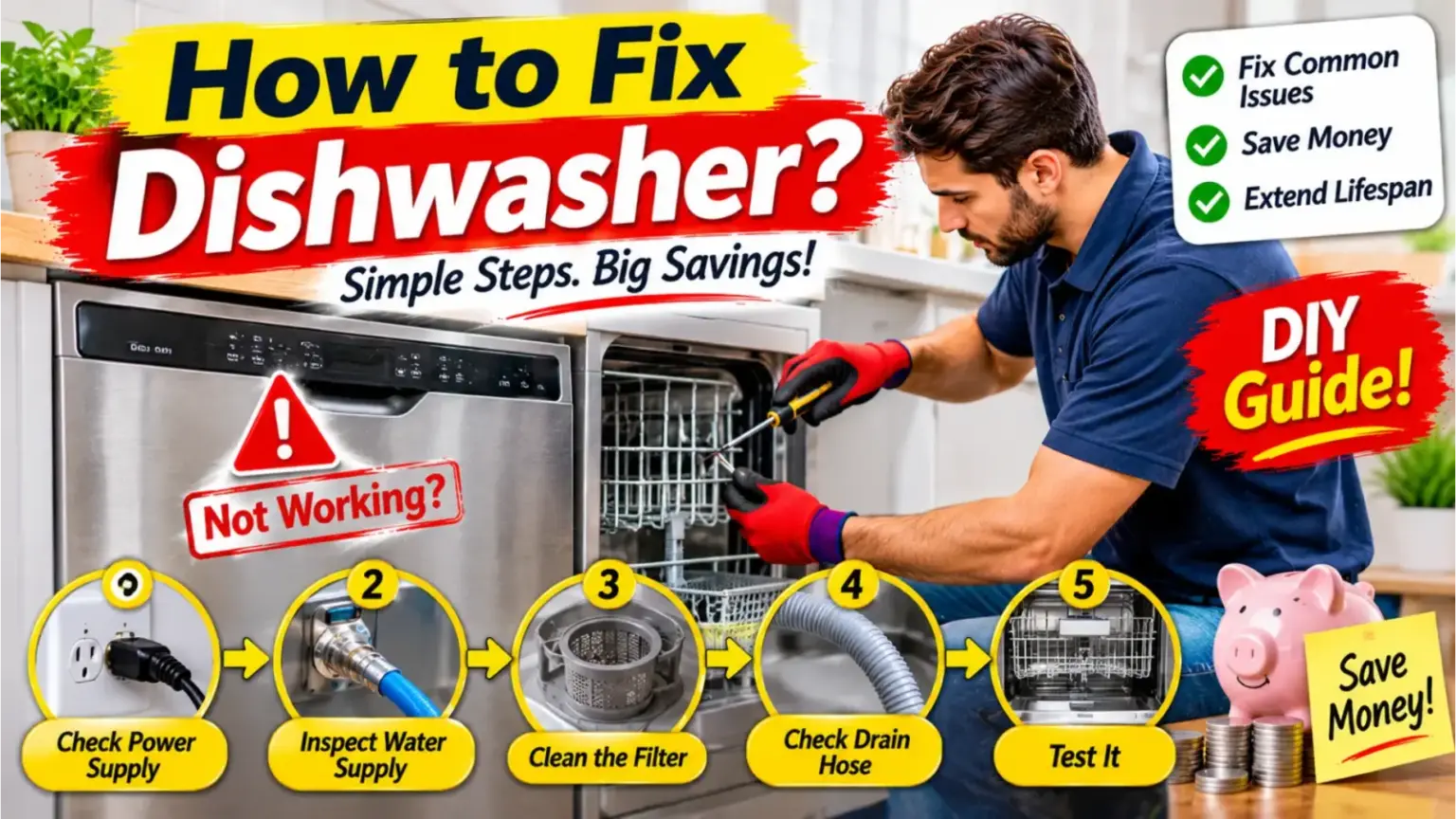
Here’s the quick answer on how to fix dishwasher problems: start with the simple checks that solve most issues. Clean the filter at the bottom of the tub, reset the dishwasher (hold Start or Cancel for a few seconds, or turn the power off for a minute), check the drain hose and garbage disposal for clogs, and make sure the spray arms spin freely. Many “broken” dishwashers are really just clogged, locked, or stuck in a cycle.
This guide walks you through each common problem: a dishwasher that won’t drain, won’t clean, won’t start, leaks, won’t dry, or makes noise. You’ll find the likely causes, step-by-step fixes, and clear signs that it’s time to call a repair pro or replace the machine.
Safety First Before Any Dishwasher Repair
- Turn off the power at the circuit breaker, or unplug the dishwasher under the sink, before removing panels or parts.
- Turn off the water supply valve under the sink before working on hoses or the inlet valve.
- Let it cool. Water and the heating element can be very hot right after a cycle.
- Wear gloves. Filters and sumps can hide broken glass.
- Have towels ready for standing water.
Tools You May Need
- Screwdrivers (Phillips and flat-head) and a Torx driver, which many dishwashers use
- Nut driver or socket set for hose clamps and panels
- Flashlight to see under the unit and into the sump
- Towels, a bucket, and a small cup for water
- Soft brush and toothpicks for filters and spray arm holes
- Multimeter (optional) for testing parts like the inlet valve or heating element
Quick Dishwasher Troubleshooting Chart
| Problem | Most Common Causes | First Thing to Try |
|---|---|---|
| Won’t drain | Clogged filter, drain hose, garbage disposal, or air gap | Clean the filter and run the disposal |
| Not cleaning well | Dirty filter, clogged spray arms, overloading, low water temperature | Clean filter and spray arms; run hot water first |
| Won’t start | Door not latched, child lock, tripped breaker, delay start | Check door, lock, and power; reset |
| Leaking | Worn door gasket, wrong detergent, loose hose, unlevel unit | Check gasket and detergent |
| Not drying | No rinse aid, heated dry off, plastic items | Add rinse aid; use heated dry |
| Noisy | Object in pump or spray arm, worn pump | Clean sump and check spray arms |
| Not filling | Water supply off, float stuck, bad inlet valve | Check water valve and float |
| Bad smell | Food in filter, standing water | Clean filter; run a cleaning cycle |
How to Reset a Dishwasher
A reset clears small control glitches and cancels a stuck cycle. Try it before anything else.
- Press and hold Start/Reset or Cancel for about 3 to 5 seconds. Many models will cancel the cycle and drain.
- If that doesn’t work, cut the power. Turn off the breaker or unplug the dishwasher for about 1 to 5 minutes.
- Restore power and start a short cycle to test.
| Brand | Common Reset Method |
|---|---|
| Bosch | Hold Start (or Start/Reset) about 3 seconds; this cancels and drains |
| GE | Press or hold Start/Reset; some models have a reset behind the kick plate |
| Whirlpool, KitchenAid, Maytag | Press Cancel/Drain or hold Start/Cancel a few seconds |
| Samsung, LG | Hold Power or Start a few seconds, or power cycle at the breaker |
| Kenmore | Depends on who made it; check the model number and manual |
Button names vary by model, so check your manual if these don’t match your control panel.
Dishwasher Not Draining
Standing water in the bottom of the tub is the most common dishwasher problem. Work through these fixes in order.
Whirlpool’s support guide explains how the drain works: at the end of a cycle, the drain pump pushes water through the drain hose to the sink drain, an air gap, or a garbage disposal, and a high loop in the hose or a working air gap keeps dirty water from flowing back in.
Step 1: Clean the Dishwasher Filter
- Remove the bottom rack.
- Find the filter, usually a round cylinder under the lower spray arm.
- Twist and lift it out, often a quarter turn counterclockwise.
- Rinse it under warm water and scrub with a soft brush and dish soap.
- Check the sump below for food, glass, or bones.
- Reinstall the filter and lock it in place.
Many modern dishwashers have manual filters that need cleaning about once a month, or more if you don’t rinse dishes.
Step 2: Run the Garbage Disposal
If your dishwasher drains through the garbage disposal, a full or clogged disposal can block it. Run the disposal with cold water for about 30 seconds, then try draining again.
Step 3: Check for a Disposal Knockout Plug
If you just installed a new garbage disposal and the dishwasher stopped draining, the knockout plug was likely never removed, as iFixit also points out. It’s a small disc inside the disposal’s dishwasher inlet. Turn off the disposal’s power, remove the drain hose, knock the plug out with a screwdriver and hammer, and retrieve it from inside the disposal.
Step 4: Clean the Air Gap
Some sinks have an air gap, a small chrome cap near the faucet. If water spits out of it during draining, it’s clogged. Pull or twist off the cap, remove the inner cover, and clear debris with a small brush or a bent wire.
Step 5: Check the Drain Hose
- Look for kinks behind and under the dishwasher.
- Check for a high loop. The hose should rise up under the counter before going down to the drain, unless you have an air gap.
- Disconnect and flush the hose at the sink end if needed. Have a bucket ready.
Step 6: Check the Drain Pump
If everything else is clear, the drain pump may be jammed or broken. A humming sound with no draining often means something is stuck in the pump impeller. Remove the filter, check the sump for debris like glass or olive pits, and carefully clear it. If the pump still won’t run, it may need replacement.
How to Drain a Dishwasher With Standing Water
Cancel the cycle so the machine tries to drain. If water remains, turn off the power, scoop out water with a cup, and soak up the rest with towels or a turkey baster before working on the filter.
Dishwasher Not Cleaning Dishes Well
- Clean the filter as shown above. A clogged filter recirculates dirty water.
- Clean the spray arms. Remove them (most twist or unclip), rinse, and clear clogged holes with a toothpick.
- Make sure spray arms spin freely and aren’t blocked by tall items.
- Run the kitchen faucet hot before starting so the dishwasher fills with hot water.
- Don’t overload. Dishes should face the spray arms with space between them.
- Use fresh detergent. Old powder clumps and pods can get damp.
- Use rinse aid, especially with hard water.
- Check the detergent door opens during the cycle. If not, it may be blocked by a tall pan.
Cloudy Glasses and White Film
White spots or film usually mean hard water minerals. Use rinse aid, add a dishwasher cleaner monthly, and consider a detergent made for hard water. Run an empty cycle with a cup of white vinegar on the top rack to remove buildup. Etched glass that stays cloudy after cleaning is permanent damage, often from too much detergent with soft water.
Dishwasher Won’t Start
- Is the door fully latched? Push it firmly closed. A worn latch may need replacement.
- Is the child lock or control lock on? Look for a lock icon and hold the lock button for a few seconds.
- Is delay start set? Cancel it and start again.
- Is there power? Check the breaker, the wall switch (some dishwashers are on a switch near the sink), and the plug.
- Is it in demo mode? Some models have a showroom mode that lights up but won’t wash. Check the manual to exit it.
- Try a reset as described above.
If the panel is completely dark and the power is on, the door switch, thermal fuse, or control board may have failed, which usually needs a repair pro.
Dishwasher Leaking
- Check the door gasket. Look for cracks, gaps, or food stuck in the rubber seal. Clean it, or replace it if damaged.
- Use only dishwasher detergent. Regular dish soap makes huge suds that leak out the door.
- Check that it’s level. A dishwasher that tilts forward can leak at the door. Adjust the front feet.
- Look under the unit. With power off, remove the kick plate and check the water supply line, drain hose, and inlet valve for drips.
- Check the spray arms. A cracked or loose arm can spray water at the door.
Water on the floor can damage cabinets and flooring fast. If you can’t find the leak, turn off the water supply and call a pro.
Dishwasher Not Drying Dishes
- Add rinse aid. It’s one of the biggest factors in drying, especially in newer energy-efficient models.
- Turn on heated dry or an extra dry option if your model has it.
- Open the door slightly after the cycle to let steam escape.
- Expect plastic to stay wet. Plastic doesn’t hold heat like glass and ceramic.
- Unload the bottom rack first so water from the top doesn’t drip down.
If dishes stay cold and wet with rinse aid and heated dry on, the heating element or thermostat may have failed.
Dishwasher Not Filling With Water
- Check the water supply valve under the sink is fully open.
- Check the float. It’s a small plastic dome or cylinder in the tub. Make sure it moves up and down freely.
- Check the inlet hose for kinks.
- Test the water inlet valve. A humming sound with no water usually means a bad valve, which often needs replacing.
Detergent Not Dissolving or Dispenser Not Opening
Finding a pod or clump of detergent stuck in the cup after a cycle means the dispenser didn’t open, or the water wasn’t hot enough to dissolve it.
- Check for blockers. Tall pans, cutting boards, or a large plate on the bottom rack can hold the dispenser door shut.
- Make sure the cup is dry before adding detergent, so it doesn’t stick.
- Run hot water at the sink before starting.
- Clean the dispenser and latch with a damp cloth to remove old detergent buildup.
- Test the spring. If the dispenser door won’t snap open by hand, the latch or spring may be broken and need a replacement dispenser.
Pods placed loose in the bottom of the tub can dissolve too early, so use the dispenser unless the package says otherwise.
Dishwasher Making Noise or Smelling Bad
Strange Noises
Grinding or rattling often means something like glass, a bone, or a utensil is caught in the pump or under the spray arm. Turn off power, remove the filter, and check the sump. Loud humming with no washing can point to a worn wash pump motor.
Bad Smell
- Clean the filter and sump.
- Wipe the door gasket and the bottom edge of the door.
- Run a hot empty cycle with a dishwasher cleaner or a cup of white vinegar upright on the top rack.
- Sprinkle a cup of baking soda on the bottom and run a short hot rinse.
- Leave the door cracked open between uses so it can dry.
Understanding Dishwasher Error Codes
Many dishwashers show codes like E15, E24, F2, or OE. Codes differ by brand, so look yours up in the manual or on the maker’s website. Here are some common examples.
| Brand | Common Code | Usual Meaning |
|---|---|---|
| Bosch | E15 | Water in the base pan (a leak); turn off, find the leak, and dry the base |
| Bosch | E24 or E25 | Drain problem; clean filter, check hose and pump |
| LG | OE | Drain error |
| LG | IE | Water inlet error (not filling) |
| Samsung | LC or LE | Leak detected |
| Samsung | 5C or 5E | Drain error |
Confirm the meaning for your exact model before replacing parts.
Common Dishwasher Parts You Can Replace
| Part | Signs It’s Bad | DIY Difficulty |
|---|---|---|
| Filter | Torn mesh, won’t lock in | Easy |
| Spray arm | Cracked, won’t spin | Easy |
| Door gasket | Cracked, leaking door | Easy to moderate |
| Rack wheels | Rack sticks or falls off track | Easy |
| Door latch | Door won’t stay closed or won’t start | Moderate |
| Water inlet valve | Won’t fill, or hums without water | Moderate |
| Drain pump | Hums but won’t drain, with clear hose and filter | Moderate to hard |
| Heating element | Dishes cold and wet, water not heating | Moderate to hard |
| Control board | Dead panel, random errors | Hard; often a pro job |
Always order parts by your model number, usually on a sticker along the edge of the door or inside the tub.
Repair or Replace Your Dishwasher?
Consider replacing instead of repairing if:
- The dishwasher is about 10 years old or more and needs a major part like a pump or control board
- The repair costs about half the price of a new one or more
- The tub is rusted or cracked
- It keeps breaking down with different problems
Repair costs vary by brand, part, and location, so get a written quote that lists parts and labor. Simple fixes like cleaning filters, resetting, and replacing a gasket or spray arm are usually well worth doing yourself.
How to Prevent Dishwasher Problems
- Clean the filter about once a month.
- Scrape food into the trash before loading.
- Run the garbage disposal before starting the dishwasher.
- Use rinse aid and the right amount of detergent.
- Run a cleaning cycle monthly with dishwasher cleaner or vinegar.
- Run hot water at the sink before starting.
- Check spray arms every few months for clogged holes.
- Load correctly, with nothing blocking the spray arms or detergent door.
Frequently Asked Questions
Why is there water in the bottom of my dishwasher?
A small amount of water around the filter can be normal on some models. Standing water above the filter usually means a clog in the filter, drain hose, air gap, or garbage disposal, or a drain pump problem.
How do I know if my dishwasher pump is bad?
If the filter, hose, disposal, and air gap are all clear but the dishwasher hums without draining or makes grinding noises, the drain pump may be jammed or failing.
Can I use dish soap in a dishwasher?
No. Regular dish soap creates too many suds, which can leak out of the door and flood your floor. Use only detergent made for dishwashers.
Why does my dishwasher stop mid-cycle?
Common causes include a door that isn’t fully latched, a power interruption, a tripped breaker, or a safety shutoff from a leak. Reset the dishwasher and check the door latch.
How long do dishwashers last?
Many dishwashers last around 9 to 12 years with regular care, though it depends on the brand, use, and water quality.
The Bottom Line
Now you know how to fix dishwasher problems step by step. Start with a reset and a clean filter, then check the drain hose, garbage disposal, air gap, spray arms, and door gasket. Most issues are clogs or simple wear parts you can handle yourself. Call a pro for leaks you can’t find, dead control panels, or bad pumps and heating elements.
Keep reading
 Cleaning
How to Clean Baseboard Heaters Safely and Thoroughly
 Electrical
How to Wire a 3-Way Switch: Step-by-Step With Diagrams
More in Appliances →