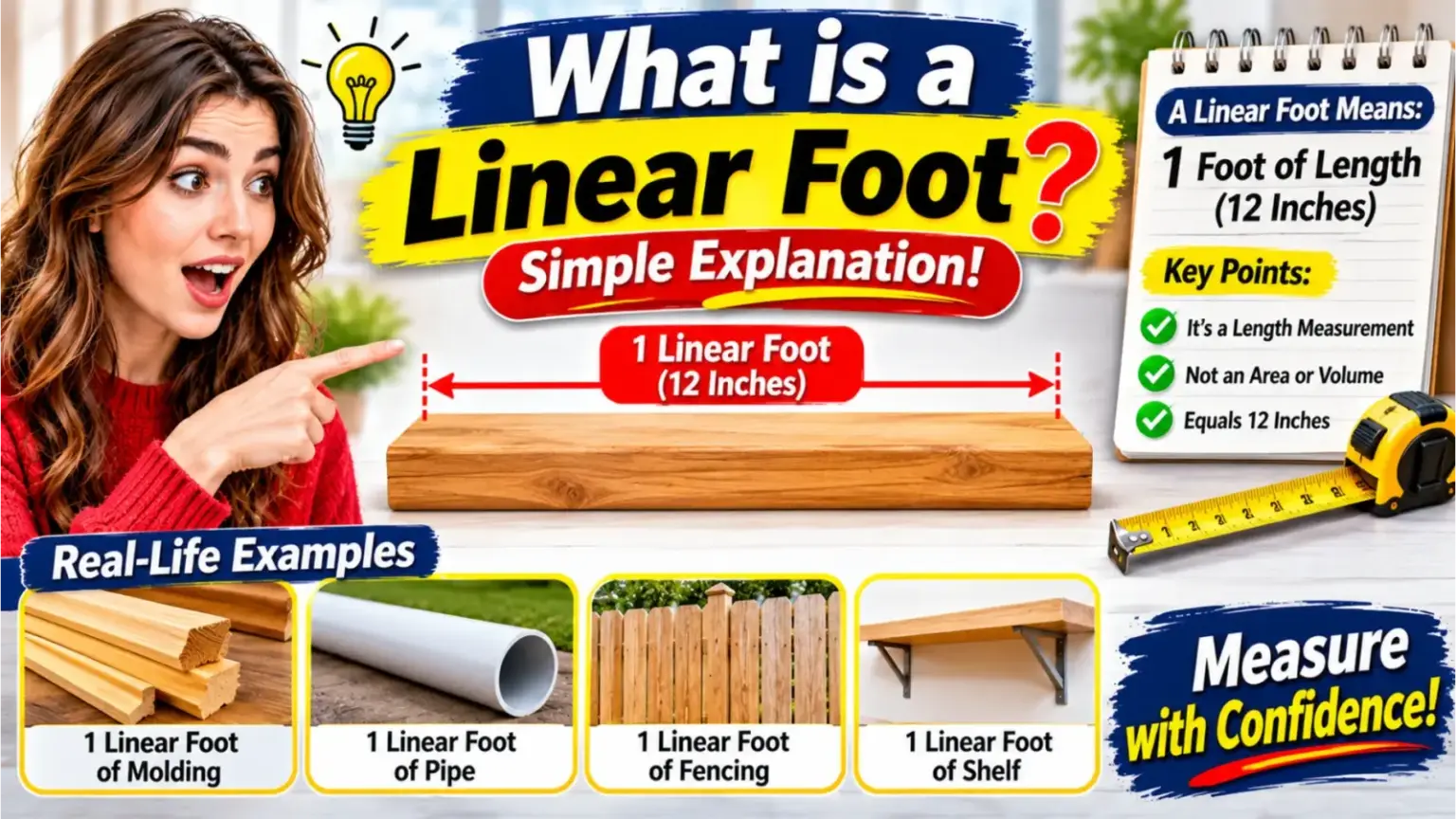
What Is a Linear Foot? Meaning, Formula, and Examples
Here’s the quick answer to what is a linear foot: a linear foot is 12 inches of length measured in a straight line. It’s the same as a regular foot. The word “linear” just tells you that only length counts, not width, height, or thickness. A board that’s 8 feet long is 8 linear feet whether it’s 2 inches wide or 12 inches wide.
You’ll see linear feet (also called lineal feet, running feet, or LF) when buying trim, baseboard, lumber, fencing, countertops, cabinets, and gutters, and when renting space on a moving truck. This guide explains how to measure and calculate linear feet, how it differs from square feet, cubic feet, and board feet, and how to use it on real projects.
Linear Foot Meaning in Plain Words
- 1 linear foot = 1 foot = 12 inches.
- It measures one dimension: length, along a straight line.
- It ignores width and thickness. A 1-inch-wide strip and a 24-inch-wide shelf can both be 1 linear foot long.
- Abbreviations: LF, lin. ft., or ln ft. You may also see “lineal foot” (same meaning) or “running foot.”
Sellers use the word “linear” mainly to make clear that the price or amount is based on length only, not on area like square feet.
How Long Is a Linear Foot?
A linear foot is exactly the length of a standard 12-inch ruler. In metric terms, the international foot is defined as exactly 0.3048 meters, according to NOAA’s National Ocean Service.
| Linear Feet | Inches | Yards | Meters | Centimeters |
|---|---|---|---|---|
| 1 | 12 | 0.333 | 0.3048 | 30.48 |
| 2 | 24 | 0.667 | 0.6096 | 60.96 |
| 3 | 36 | 1 | 0.9144 | 91.44 |
| 5 | 60 | 1.667 | 1.524 | 152.4 |
| 8 | 96 | 2.667 | 2.4384 | 243.84 |
| 10 | 120 | 3.333 | 3.048 | 304.8 |
| 12 | 144 | 4 | 3.6576 | 365.76 |
| 16 | 192 | 5.333 | 4.8768 | 487.68 |
| 20 | 240 | 6.667 | 6.096 | 609.6 |
| 100 | 1,200 | 33.333 | 30.48 | 3,048 |
Linear Feet vs Square Feet vs Cubic Feet vs Board Feet
These terms get mixed up a lot, and mixing them up can cost you money when buying materials.
| Unit | What It Measures | Dimensions | Formula | Common Uses |
|---|---|---|---|---|
| Linear foot | Length | 1 | Length in feet | Trim, baseboard, fencing, lumber, gutters, countertops |
| Square foot | Area | 2 | Length x width | Flooring, carpet, tile, paint coverage, drywall, home size |
| Cubic foot | Volume | 3 | Length x width x height | Mulch, soil, concrete, storage units, fridges, boxes |
| Board foot | Volume of lumber | 3 | Thickness (in) x width (in) x length (in) / 144 | Hardwood lumber sold by volume |
- A square foot is a 12 x 12 inch square, or 144 square inches.
- A cubic foot is a 12 x 12 x 12 inch cube, or 1,728 cubic inches.
- A board foot is a piece of wood 1 inch thick, 12 inches wide, and 12 inches long, or 144 cubic inches.
Is a Linear Foot the Same as a Foot?
Yes. A linear foot and a foot are the same length: 12 inches. “Linear” is just a label that tells you width and height don’t matter for that measurement.
Linear Foot vs Board Foot
This is the most expensive mix-up in woodworking. Hardwood lumber is often priced by the board foot, which accounts for thickness and width. Common construction lumber, molding, and trim are usually priced by the linear foot. A wide, thick board has more board feet than linear feet.
Example: a board that’s 1 inch thick, 6 inches wide, and 8 feet (96 inches) long is 8 linear feet. In board feet, it’s 1 x 6 x 96 / 144 = 4 board feet. If the same board were 2 inches thick and 12 inches wide, it would still be 8 linear feet but 16 board feet.
How to Calculate Linear Feet
The basic linear foot formula is simple: measure the length and convert it to feet.
- From inches: linear feet = inches / 12
- From yards: linear feet = yards x 3
- From meters: linear feet = meters / 0.3048 (or meters x 3.281)
- From centimeters: linear feet = centimeters / 30.48
Step-by-Step: How to Measure Linear Feet
- Measure each piece or section along its length with a tape measure. Ignore width and thickness.
- Convert to the same unit. If you measured in inches, divide by 12. For feet and inches, divide the extra inches by 12 and add them to the feet.
- Add the lengths together if you have several pieces or wall sections.
- Subtract openings that won’t get material, such as doorways for baseboard.
- Add extra for waste, often about 10% for cuts, mistakes, and corners.
Example: you have three boards measuring 96 inches, 72 inches, and 54 inches. Add them: 96 + 72 + 54 = 222 inches. Divide by 12: 222 / 12 = 18.5 linear feet.
Converting Feet and Inches
For a measurement like 10 feet 9 inches, divide the 9 inches by 12 to get 0.75, then add it: 10.75 linear feet.
How to Convert Square Feet to Linear Feet
You can’t convert square feet to linear feet without knowing the width of the material. Once you know the width, use this formula:
Linear feet = square feet / width in feet
Turn the width into feet first by dividing inches by 12.
| Board or Material Width | Width in Feet | Linear Feet per 100 Sq Ft |
|---|---|---|
| 3 inches | 0.25 | 400 |
| 4 inches | 0.333 | 300 |
| 5.5 inches | 0.458 | 218 |
| 6 inches | 0.5 | 200 |
| 8 inches | 0.667 | 150 |
| 12 inches | 1 | 100 |
| 24 inches | 2 | 50 |
Example: you want to cover a 120-square-foot wall with 6-inch-wide shiplap. 120 / 0.5 = 240 linear feet of boards, plus about 10% waste, so plan on about 264 linear feet. To go the other way, linear feet x width in feet = square feet.
Linear Feet of a Room (Perimeter)
For trim, baseboard, crown molding, and chair rail, you usually need the room’s perimeter: the total length of all walls added together.
Perimeter of a rectangular room = 2 x (length + width)
| Room Size | Perimeter (Linear Feet) | Floor Area (Square Feet) |
|---|---|---|
| 8 x 10 | 36 | 80 |
| 10 x 10 | 40 | 100 |
| 10 x 12 | 44 | 120 |
| 12 x 12 | 48 | 144 |
| 12 x 14 | 52 | 168 |
| 12 x 16 | 56 | 192 |
| 14 x 16 | 60 | 224 |
| 16 x 20 | 72 | 320 |
| 20 x 20 | 80 | 400 |
For baseboard, subtract the width of door openings. A standard interior doorway is often about 3 feet wide, but measure yours. For L-shaped or odd rooms, measure every wall and add them up.
How Linear Feet Are Used in Home Projects
Baseboard, Trim, and Molding
Trim is almost always sold by the linear foot or in fixed lengths such as 8, 12, or 16 feet. Measure the walls, subtract doorways, add about 10% to 15% for miter cuts and waste, then divide by the stick length to see how many pieces to buy.
Example: a 12 x 14 room has a 52-foot perimeter. Subtract one 3-foot door: 49 linear feet. Add 10%: about 54 linear feet. With 16-foot pieces, 54 / 16 = 3.4, so buy 4 pieces.
Fencing
A linear foot of fence is one foot of fence line along the ground. Measure the full fence line, subtract any existing structures, and plan for gates separately. Fence installers often quote a price per linear foot that may include posts, panels, and labor.
Lumber and Decking
Dimensional lumber like 2x4s and deck boards is usually sold by the piece in set lengths, but some yards price it per linear foot. To compare, divide the price of a board by its length in feet.
Countertops and Cabinets
Kitchen cabinets are often quoted per linear foot of cabinet run along the wall. Measure along the wall where the cabinets will sit. Upper and lower cabinets are usually counted separately. Countertops may be priced by the square foot or the linear foot, so ask which one a quote uses.
Gutters, Pipe, and Wire
Gutters, PVC pipe, electrical wire, cable, and tubing are all measured by length. Measure the run, add extra for bends and connections, and buy a little more than you need.
Fabric and Rolled Goods
Fabric, vinyl, and some rolled materials are sold by the linear yard or linear foot off a roll of fixed width. You pay for the length you unroll, no matter how wide the roll is.
Quick Guide: What to Measure for Each Project
| Project | What to Measure | Typical Waste Allowance |
|---|---|---|
| Baseboard | Room perimeter minus doorways | About 10% to 15% |
| Crown molding | Full room perimeter at the ceiling | About 10% to 15% |
| Fence | Fence line along the ground | Plan posts and gates separately |
| Deck boards | Deck area divided by board width | About 10% |
| Shiplap or wall planks | Wall area divided by board width | About 10% |
| Gutters | Length of each roof edge that drains | Extra for corners and downspouts |
| Cabinets | Wall length where cabinets will sit | None; round to cabinet sizes |
| Edging or garden border | Length along the bed edge, following curves | About 5% to 10% |
Waste allowances are general rules of thumb. Complex rooms with many corners, patterned materials, and beginner installs usually need more.
How to Measure Curved or Irregular Lengths
Not everything runs in a straight line. For curved garden beds, round tables, or winding paths:
- Use a flexible tape measure or a piece of string laid along the curve, then measure the string.
- Break it into short straight sections and add them together.
- For a circle, the distance around is about 3.14 x the diameter. A 10-foot-wide round bed has an edge of about 31.4 linear feet.
- Use a measuring wheel for long outdoor runs like fence lines and driveways.
Tools for Measuring Linear Feet
- Tape measure: the go-to tool for most indoor projects. A 25-foot tape covers most rooms.
- Laser distance measurer: fast and accurate for long walls and ceilings, and handy when working alone.
- Measuring wheel: best for fences, yards, and driveways.
- Folding ruler or yardstick: useful for short pieces and checking cuts.
- Pencil and notepad or phone: write down every measurement as you go, labeled by wall or piece.
How to Estimate Cost per Linear Foot
Many quotes and price tags use a cost per linear foot. To estimate your total:
- Find your total linear feet, including waste.
- Multiply by the price per linear foot.
- Add extras like fasteners, adhesive, posts, gates, end caps, delivery, and labor if they aren’t included.
Hypothetical example: you need 54 linear feet of baseboard priced at $1.50 per linear foot. 54 x 1.50 = $81 in trim, plus nails, caulk, and paint. Prices vary by material and location, so always check current local pricing.
Linear Feet in Moving, Shipping, and Storage
Moving and freight companies often price by the linear foot of truck or trailer space your items take up, measured front to back along the floor. For example, a shipment using 10 feet of a trailer’s length is 10 linear feet, even if it doesn’t reach the ceiling.
- Measure the length your stacked boxes and furniture will take up along the truck floor.
- Stack tightly and use the full height and width to reduce linear footage.
- Ask the mover how they measure, since policies vary.
Linear Feet in Archives and Libraries
Archivists use linear feet to describe how much shelf space a collection fills. A collection described as 10 linear feet takes up 10 feet of shelf length when the boxes or folders are lined up.
Worked Examples: Linear Feet in Real Projects
These hypothetical examples show the full process from measuring to buying.
Example 1: Fencing a Backyard
Your yard’s back side is 60 feet, and the two sides are 40 feet each, with the house closing off the front. 60 + 40 + 40 = 140 linear feet of fence line. If you want a 4-foot gate, you’d buy 136 linear feet of fence panels plus one gate. With 8-foot panels, 136 / 8 = 17 panels.
Example 2: Shiplap on an Accent Wall
The wall is 12 feet wide and 8 feet tall, so it’s 96 square feet. Boards have a 5.5-inch face width, or 0.458 feet. 96 / 0.458 = about 210 linear feet. Add 10% waste, and you’ll need about 231 linear feet. With 8-foot boards, that’s 231 / 8 = 29 boards, rounded up.
Common Linear Foot Mistakes
- Confusing linear feet with square feet. A 10 x 10 room is 100 square feet of floor but only 40 linear feet of wall.
- Confusing linear feet with board feet when buying hardwood.
- Forgetting to convert inches. Always divide inches by 12 before adding to feet.
- Skipping waste. Cuts, corners, and mistakes add up.
- Not subtracting openings for doorways or gates, which can lead to buying too much.
- Ignoring stick length. You can’t buy 3.4 pieces of trim, so round up.
Frequently Asked Questions
How many inches are in a linear foot?
There are 12 inches in a linear foot, the same as a regular foot.
How many linear feet are in a 10×10 room?
A 10 x 10 room has a perimeter of 40 linear feet: 10 + 10 + 10 + 10.
What is the linear feet of a 12×12 room?
A 12 x 12 room has 48 linear feet of wall around it. The floor area is 144 square feet.
What does a linear foot look like?
Picture a standard 12-inch ruler laid flat. That length is one linear foot, no matter how wide the object is.
Is lineal the same as linear?
Yes. “Lineal foot” and “linear foot” mean the same thing in construction and retail.
How do you calculate the price per linear foot?
Divide the total price by the total length in feet. For example, a 12-foot board priced at $24 costs $2 per linear foot.
How many linear feet are in a square foot?
It depends on the material’s width. For a 12-inch-wide material, 1 square foot equals 1 linear foot. For a 6-inch-wide board, 1 square foot equals 2 linear feet.
What is a linear foot of fence?
It’s one foot of fence length along the ground, measured along the fence line, regardless of fence height.
How many linear feet are in a yard or a mile?
There are 3 linear feet in a yard and 5,280 linear feet in a mile.
How are cabinets priced per linear foot?
The price is multiplied by the length of the cabinet run along the wall. A 10-foot wall of base cabinets is 10 linear feet. Ask whether a quote includes uppers, lowers, countertops, and installation.
The Bottom Line
So what is a linear foot? It’s simply 12 inches of length in a straight line, with no regard for width or height. Use linear feet for anything bought or priced by length, like trim, fencing, lumber, gutters, and cabinets. Measure the length, convert inches to feet, add the pieces together, subtract openings, and add about 10% for waste. When you need to cover an area, convert with the material’s width, and don’t confuse linear feet with board feet when buying wood.
Keep reading
 Home Building & Plans
Tiny Home Floor Plans: Layouts, Sizes, and Design Tips
 Walls, Paint & Finishes
PVC Wall Panels: Types, Costs, Pros, Cons, and Installation
More in DIY Tools & Measurements →